Taxis in ultra-compact kei cars are now accessible to travelers - provided you know where to find them
Japan just now0Add to bookmarks
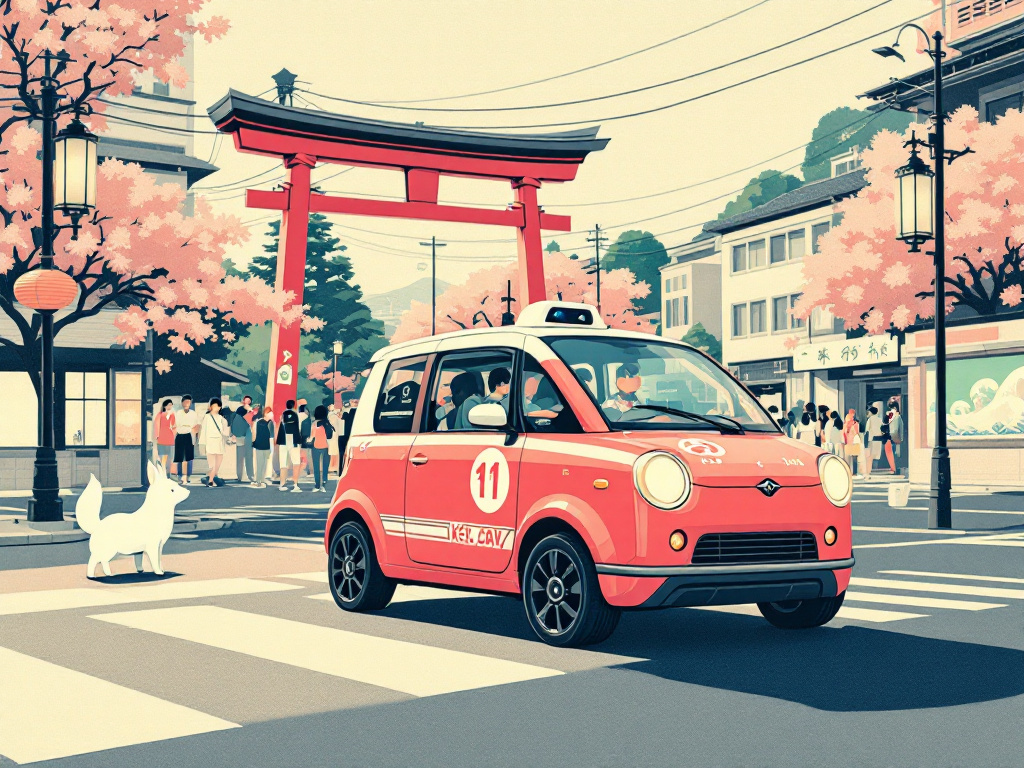
Japan is gradually opening its kei car taxis to foreign travelers. A marginal service but indicative of a profound adaptation of Japanese urban transport.
The context
SoraNews24 reports a subtle but significant evolution in Japan's on-demand transportation: kei car taxis (軽自動車タクシー, keijidōsha takushī) - these four-wheeled micro-vehicles limited to 660 cm³ and 3.4 meters in length - are now officially being offered to foreign travelers in certain areas. You just need to know where and how to hail them.
The service remains marginal in volume, but its very existence is worth explaining: it tells something about how Japan adapts its urban transportation to constraints that few other countries face.
What is a kei car?
The 軽自動車 (kei jidōsha, literally "light automobile") category was born in 1949 as a fiscal and technical class of the Japanese government, designed to democratize the car in the post-war period. Current constraints:
- Maximum engine displacement: 660 cm³
- Maximum power: 64 horsepower
- Maximum length: 3.4 m
- Maximum width: 1.48 m
- Maximum height: 2.00 m
In exchange, kei cars benefit from lower taxes, less required parking space (in some regions, proof of parking - 車庫証明, shakoshōmei - is not required), and distinctive yellow plates (compared to white plates for regular cars).
They represent today about 40% of the Japanese automobile fleet (source: Japan Automobile Manufacturers Association, JAMA, 2024 data), a unique share in the world.
Why kei car taxis?
Rural and peri-urban Japan is experiencing documented demographic contraction: villages where the average age exceeds 65 years, public transportation closing its lines, taxi drivers aging without replacement. The Ministry of Land, Infrastructure, Transport and Tourism (国土交通省, MLIT) has gradually relaxed the rules to allow small operators to deploy kei cars as taxi services - more economical to operate than conventional sedans.
These services have existed for several years in the depopulated areas of Hokkaidō, Shikoku, or Tōhoku. What changes in 2026: their gradual opening to foreigners via adapted calling platforms and multilingual signage.
Where to find them
The SoraNews24 article mentions specific areas and dedicated applications. Without reproducing in extenso what remains targeted news, the references to remember:
- Rural areas and small towns: It's not in central Tokyo or Osaka that you'll encounter a kei car taxi, but in less dense prefectures (Nagano, Yamanashi, mountainous prefectures of the Kansai region).
- Calling applications: Major platforms (GO, edited by Mobility Technologies, or Uber Japan) are beginning to integrate these vehicles into their local pools.
- Signage: Lantern (行灯, andon) on the roof, yellow plate, タクシー mention affixed.
What it reveals
It would be easy to treat this information as a folkloric curiosity. It is better understood as a symptom of adaptation: rural Japan is looking for solutions to the demographic collapse of its low-density areas, and kei cars, fuel-efficient, easy to park, adapted to narrow roads, lend themselves naturally to this.
The opposite logic exists: in large cities, the trend is towards larger vehicles (crossovers, compact SUVs) for family use. The coexistence of the two trends - rural micromobility, urban over-motorization - is one of the structural issues of Japanese transportation for the years to come.
For the traveler, the opportunity is beautiful: getting into a kei car taxi in a small prefectural village is living a Japan rarely visible from standard tourist circuits. Provided you accept that the comfort is not that of a Toyota Crown, and that the journey is done at the pace of country roads.
Sources
- SoraNews24: "Japan's ultracompact kei car taxis are now ready for travelers to ride, if you know where to find them"
- Japan Automobile Manufacturers Association (JAMA): fleet statistics, www.jama.or.jp
Article produced by artificial intelligence, reviewed under human editorial control.